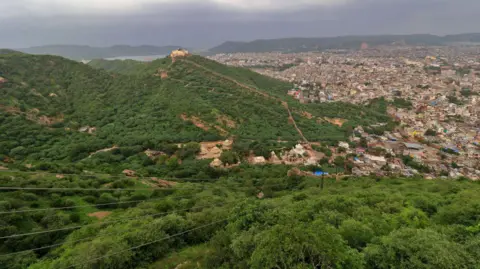
India’s Aravalli Range – ancient, weathered, and indispensable – now hangs by a dangerously thin thread. A recent satellite audit by the “We Are Aravalli” collective reveals that 31.8% of this critical mountain chain loses legal protection under the Centre’s arbitrary 100-meter height classification. This isn’t mere technicality; it’s an ecological catastrophe in waiting. As someone deeply invested in Rajasthan’s future – from Jaipur’s water security to the desert’s relentless advance – I see this as a pivotal moment where science must trump bureaucratic convenience.
Consider the stakes. The Aravallis aren’t dramatic Himalayan peaks; they’re subtle, rolling hills stretching from Gujarat through Rajasthan, Haryana, to Delhi. Their low-elevation ridges – now suddenly “unprotected” – serve as primary groundwater recharge zones for 30 crore people. Jaipur, Gurugram, and Delhi depend on these aquifers. Strip away protection, and mining leases proliferate, shattering rock formations that have filtered rainwater for millennia. The Thar Desert, already encroaching, finds its final natural barrier crumbling.
Climate scientist Sudhanshu’s FABDEM analysis exposes the Centre’s 0.19% “affected area” claim as geological fiction. Low hills aren’t wasteland; they’re dust traps and windbreaks. Remove them, and PM2.5 levels – already choking Delhi-NCR – skyrocket. We’re not talking theoretical pollution; this directly worsens the winter smog that sends hospital admissions soaring. The collective’s data proves these “sub-100m” zones sustain biodiversity hotspots and prevent fertile plains from desertification.
Yet government’s response feels like willful blindness. The Supreme Court’s stay on its own November directives suggests judicial hesitation, but doesn’t resolve the core issue: height-based classification ignores Aravalli’s geomorphology. Hills don’t need to tower 100 meters to function ecologically. This threshold suits mining lobbies, not science. Existing leases in Chittorgarh, Nagaur, Bundi, Kaman, and Sawai Madhopur should be revoked immediately – their ecological devastation is documented.
What solution emerges? Declare the entire Aravalli a “fully protected zone.” Abolish artificial hill/mountain distinctions. Permit only strategic rare-earth mining under military oversight. Mandate state-led reclamation: soil restoration, native kejri and khejri tree plantations, water-harvesting structures. Gujarat, Rajasthan, Haryana, and Delhi must coordinate – or watch their shared lifeline vanish.
This transcends environment; it’s economic suicide. Mining provides short-term jobs but destroys tourism, agriculture, and real estate values. Protected Aravallis could anchor eco-tourism circuits, carbon credit schemes, and biodiversity offsets. Imagine heritage trails through reclaimed ridges versus scarred moonscapes.
Critics will cry “anti-development.” Reality check: unprotected Aravallis mean costlier water tankers, higher healthcare bills from respiratory diseases, and desert-expanded wastelands unfit for farming. Haryana’s groundwater crisis and Delhi’s air emergency aren’t natural; they’re policy failures.
Rajasthan, my home state, bears disproportionate risk. Jaipur’s reservoirs trace back to Aravalli catchments. Udaipur’s lakes, Alwar’s siliserh – all vulnerable. Governor Kalraj Mishra must champion full protection in state cabinet. Chief Minister Bhajanlal Sharma, already tackling drunk-driving outrage, should pivot to this existential threat.
Nationally, this tests Environment Minister Bhupender Yadav’s credibility. PIB fact-sheets tout “sustainable development,” but actions contradict. The Aravalli Green Wall Project – noble on paper – falters without mining bans.
Ultimately, this demands political courage. Voters reward water security and clean air more than mine-owner donations. The “We Are Aravalli” collective shows people-led science can challenge official narratives. Their Jaipur clarion call merits amplification through every newsroom.
India cannot afford to lose its oldest mountain guardian. 31.8% at risk today becomes 100% catastrophe tomorrow. Protect the entire range, or inherit dust-choked regret.