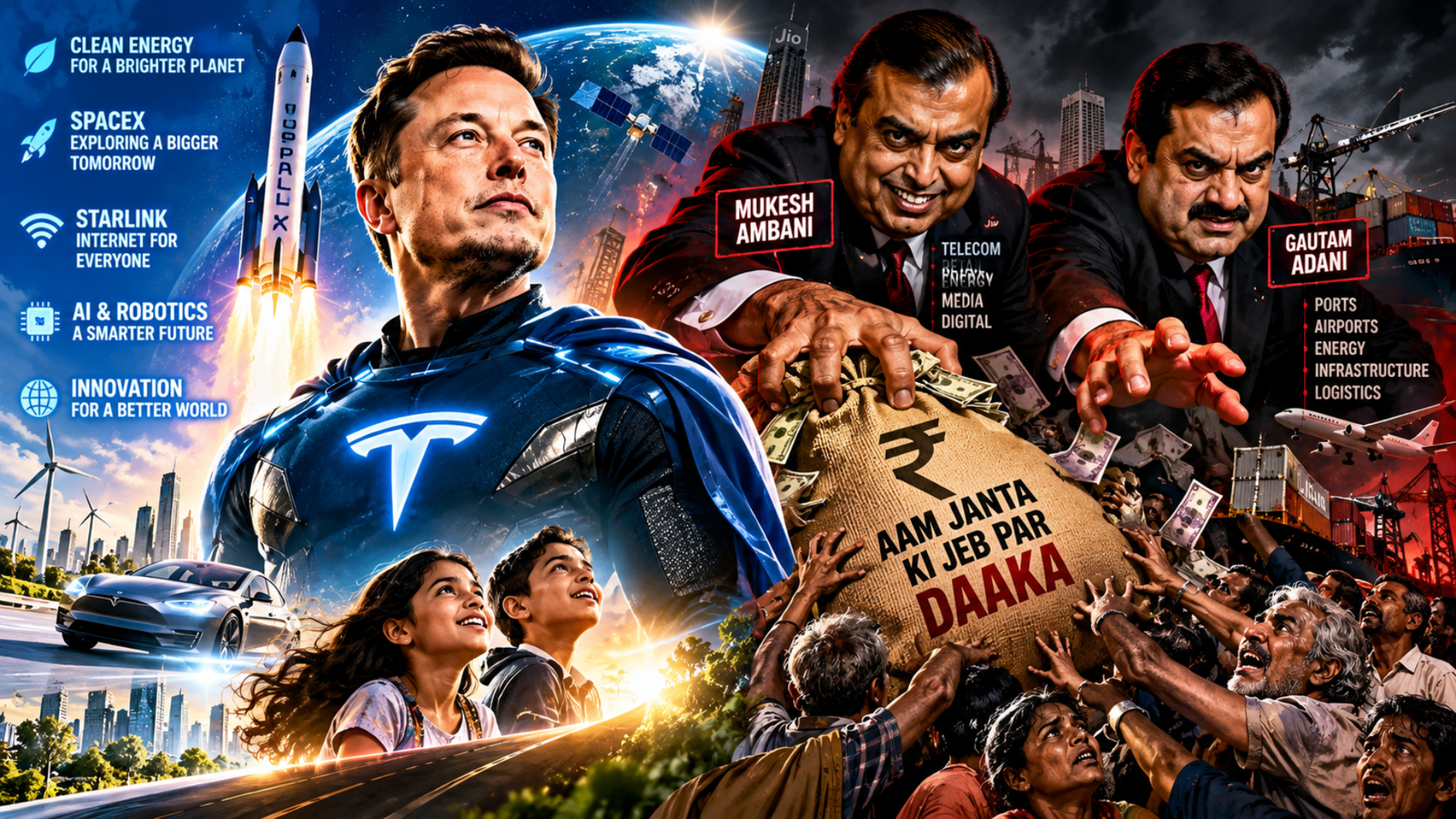
In today’s world, a handful of billionaires possess more economic power than entire nations. Their decisions influence the jobs we get, the technology we use, the prices we pay, and even the future our children will inherit. But an important question remains: Are billionaires using their wealth to transform humanity, or are they simply expanding their empires while ordinary people struggle to survive?
When we look at Elon Musk, Gautam Adani, and Mukesh Ambani, we see three powerful business figures whose decisions have consequences far beyond their personal fortunes. However, their business journeys also raise a broader debate about the purpose of wealth, the responsibility of corporations, and the difference between creating something revolutionary and controlling something essential.
For many admirers of technological innovation, Elon Musk represents the ambition to challenge established industries. For critics of concentrated corporate power in India, the growing influence of large business groups raises uncomfortable questions about competition, affordability, and whether economic growth is reaching the common man.
The comparison deserves serious discussion.
Elon Musk: Betting on Technologies That Could Change Humanity
Elon Musk has built a reputation for pursuing projects that once seemed unrealistic to many people. Through Tesla, he helped accelerate the global adoption of electric vehicles and pushed traditional automobile manufacturers to take electric mobility more seriously. Through SpaceX, he helped transform the economics of spaceflight by developing reusable rockets, while Starlink has expanded satellite-based internet access in many regions.
His ambitions extend into artificial intelligence, robotics, and energy storage. These industries could have significant consequences for how people work, communicate, travel, and produce energy.
The important point is not that everything Musk does is necessarily beneficial or that his companies are free from controversy. They are commercial enterprises, and their decisions deserve scrutiny like those of any other powerful corporation. Nevertheless, the technological challenges his companies have pursued demonstrate how ambitious research and development can disrupt established markets.
Innovation matters when it pushes humanity towards possibilities that previously seemed out of reach.
Electric vehicles, reusable rockets, satellite connectivity, and energy-storage technology can contribute to major changes in society. Their benefits, however, depend on affordability, accessibility, safety, and responsible implementation—not simply on the ambitions of one billionaire.
Musk’s achievements therefore offer an interesting benchmark: a successful entrepreneur should be judged not only by personal wealth, but also by the lasting value created through innovation.
Adani and Ambani: The Question Is Not Wealth, but Its Impact
India’s economic transformation has created opportunities for some of its largest business groups. Gautam Adani’s businesses operate across infrastructure, ports, airports, logistics, energy, and other sectors. Mukesh Ambani’s Reliance Industries has major interests in telecommunications, retail, energy, and digital services.
These businesses have invested in sectors that are important to India’s development. Ports connect the country to global trade, energy infrastructure supports economic activity, and telecommunications networks have made digital services accessible to millions of people.
It would therefore be inaccurate to suggest that their businesses have produced no public benefits.
But acknowledging these contributions does not mean accepting corporate power without questioning it.
When business groups become major players in essential sectors, the public deserves to know whether markets remain competitive, whether consumers receive fair value, whether smaller businesses have a reasonable chance to compete, and whether regulatory decisions protect the public interest.
The concern is not simply that Adani and Ambani are wealthy. The concern is whether concentrated economic power can create an imbalance in which the interests of large corporations receive more attention than the everyday struggles of ordinary citizens.
A company can be successful while society still has legitimate questions about affordability, competition, and accountability.
These questions should be answered with evidence, transparent reporting, and fair regulation—not blind admiration or unsupported allegations.
Is the Common Man Paying the Price?
For an ordinary Indian family, economic growth is not measured by the size of a billionaire’s fortune. It is measured by whether the monthly salary covers rent, groceries, electricity, school fees, healthcare, and transportation.
A small shopkeeper wants fair competition. A young graduate wants a decent job. A farmer wants reliable markets and reasonable costs. A salaried employee wants purchasing power that does not disappear as household expenses rise.
Against this reality, corporate announcements about record investments and expanding business empires can feel distant from everyday life.
When consumers have limited alternatives in an essential market, they may face fewer choices. When smaller businesses struggle to compete against companies with enormous resources, the consequences can extend beyond individual businesses. And when wealth becomes concentrated, citizens may reasonably question whether the benefits of economic growth are being distributed fairly.
This is where the language of daaka in the common man’s pocket captures a powerful public frustration. It expresses the feeling that ordinary people are constantly asked to pay more while the biggest economic players continue to grow.
However, that phrase should be understood as a political and economic criticism, not a literal accusation of theft or proof of wrongdoing by any particular businessman.
The real question is whether Indian consumers are getting fair prices, whether workers are receiving appropriate opportunities, and whether the benefits of private investment are translating into measurable improvements in people’s lives.
India needs a system where corporate success and public prosperity advance together.
Innovation Versus Influence: A Debate India Must Have
The contrast between Musk’s technological ambitions and India’s powerful business empires is not as simple as one billionaire being good and the others being bad.
Musk’s companies also seek profits, compete aggressively, and face criticism over business practices, workplace issues, governance, and other controversies. Meanwhile, Adani and Ambani operate businesses that contribute to infrastructure, connectivity, employment, and economic activity in India.
The meaningful distinction is not nationality, personality, or popularity. It is the measurable impact of business decisions.
Does a company create technology that improves people’s lives? Does it make essential services more accessible? Does it invest in research, develop new capabilities, and create productive employment? Does it treat customers fairly and operate transparently?
These questions should apply equally to every billionaire.
If Musk’s companies create genuine technological progress, that progress deserves recognition. If Indian corporations deliver useful infrastructure and affordable services, those contributions deserve recognition too. And if any powerful company engages in unfair practices, abuses market power, or fails to meet its obligations, it should face appropriate scrutiny and accountability.
No billionaire should be above criticism, and no billionaire should be above the rules.
The public should not have to choose between celebrating innovation and demanding economic justice.
India Needs Entrepreneurs, Not Untouchable Corporate Empires
India needs investment, industrial development, modern infrastructure, technological innovation, and entrepreneurs willing to take risks. But it also needs independent regulators, transparent institutions, meaningful competition, strong consumer protections, and opportunities for small businesses.
Economic policy should encourage companies to innovate without allowing market dominance to become an unfair advantage. Public infrastructure and essential services should be governed by rules that protect citizens. Government decisions affecting major businesses should be transparent, consistently applied, and open to scrutiny.
Most importantly, growth should be judged by its impact on the population.
Are more people finding productive employment? Are wages keeping pace with living costs? Are essential services becoming more affordable? Are smaller entrepreneurs able to compete? Is new technology improving productivity and access?
These are better measures of economic success than the number of billionaires a country produces.
The common man is not asking every entrepreneur to abandon profits. People are asking for a fair opportunity to improve their lives and a system in which success does not depend on having enormous wealth or influence.
The Final Question: Who Is Building a Better Future?
Elon Musk’s work in electric mobility, reusable rockets, and satellite connectivity illustrates the transformative potential of technological ambition. Adani and Ambani’s businesses illustrate the scale and influence that major corporate groups can acquire in a rapidly growing economy.
Both stories deserve examination, and neither should escape critical scrutiny.
But India must never confuse the growth of corporate empires with the complete success of its economy. A rising stock market, a billionaire’s expanding fortune, or a record corporate valuation does not automatically mean that every household is doing better.
The ultimate purpose of economic progress should be to expand opportunity, improve living standards, and give ordinary people greater control over their futures.
The real question is not who has the most money. It is who creates the most meaningful value for society—and whether the common man receives a fair share of that progress.
India does not need to hate its billionaires. It needs to hold them accountable. It does not need to reject capitalism. It needs capitalism that rewards innovation, protects competition, and serves the wider public.
Because a nation’s greatest achievement is not the wealth of its richest citizens. It is the opportunity, dignity, and prosperity available to its ordinary people.
And that is the standard by which every billionaire—from Elon Musk to Gautam Adani and Mukesh Ambani—should ultimately be judged.